Showing posts with label greek mythology. Show all posts

Saturday, March 9, 2013

Friday’s Mythological Creature of the Day – Muse


In honor of the International Women’s Day, this article is devoted to Muses, the Greek Goddesses, the benefactors of the arts and the sciences.  Today they are known as the nine sisters, daughters of Zeus and Mnemosyne (the Titan, personifying Remembrance). They are usually portrayed as young beautiful women, dancing or playing different musical instruments.

Each muse has her own domain and emblem (X / Y below). Their names are:

Calliope (Epic poetry / Writing Tablet, Wind). Fair-voiced. She is the first-born of the Muses, and the most powerful one, associated with the Tarot card of the Hermit. Her Anathemas are the Discordant Sounds.


Clio (Cleio) (History / Scrolls, Pens, Memory, Bards). The Proclaimer associated with the Tarot card of Justice. Her Anathemas are lies, blemishes and injustice.


Erato (Love Poetry / Cithara (a musical instrument like a lyre), Bow and Arrow).  Romantic Love, associated with the Tarot card of the Lovers. Anathemas: Magic used to destroy love.


Euterpe (Song and Elegiac Poetry / Aulos (a musical instrument like a flute). Giver of pleasure associated with the Tarot cards of the Magician and the Fool. Her Anathema is Refusal to Enjoy the Gifts of Life.
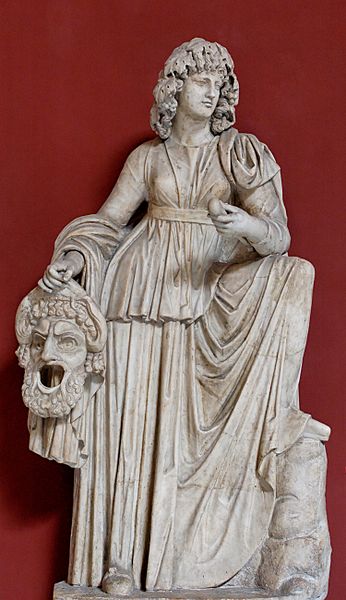


Melpomene (Tragedy / Sad Mask of the twin harlequins representing tragedy in theater). The Singer, associated with the Tarot cards of the Chariot, the Moon and the Temperance. Anathema: Frivolity – she prefers those in deep contemplation.


Polyhymnia (Hymns and Pantomime  / Veil, halos, all sacred books, reborn deities, sacred music). She is of Many Hymns, associated with the Tarot card of the High Priestess. Anathemas: Those who use her gifts without honoring their sacred source.


Terpsichore (Dance / Lyre). She is the Whirler, associated with the Tarot cards of Tower, Death or Change. Anathemas: Those who do not help themselves but want others to do for them.


Thalia (Comedy / The Laughing Mask of the twin harlequins representing comedy in the theater). The Flourisher, associated with the Tarot cards of the Chariot, the Sun and the World. Anathemas: Sadness – she cannot abide by those who refuse to enjoy.


Urania (Astronomy / Celestial Globe and Compass of Heavens) The Heavenly One, associated with the Tarot card of the Wheel of Fortune ( Sorry, Vanna White ;-)). Anathemas: Those who do not seek the answers that lie before them.


Some sources reveal that there were only three original muses Melete (Experience), Mnene (Memory, Remembering) and Aoide (Song) who in the beginning were worshiped by twin giants, the Aloadai. They were the ones attributed with the founding of the cult of Muses on Mt. Helikon. A poet Mimnerm proclaimed that there were two sets of muses (the elder ones -- daughters of Uranius (sky) and Gaia (earth) and the younger ones – the daughters of Zeus). But multiple scholars of antiquity, including Hesiod and Homer, agree that the correct number of Muses is nine.
The Muses lived on the mountain Helikon singing and praising all the generations of Gods and Goddesses: Gaia, Chronos, Ocean, Night, Helios, Zeus and his family, thus, connecting past and present. They were believed to know the past and to see the future. But at the same time, they love meddling in the affairs of the humans. They are the benefactors of musicians, writers, artists, bestowing their gifts upon them, inspiring the creative minds, advancing the civilization.
Have you ever thought that the words “muse” and “museum” are related? Indeed, they are! Many Enlightenment figures sought to re-establish a "Cult of the Muses" in the 18th century. A famous Masonic lodge in pre-Revolutionary Paris was called Les Neuf Soeurs ("the nine sisters", that is, the nine Muses) - Voltaire, Benjamin Franklin, Danton, and other influential figures of the time attended it. As a side-effect of this movement the word "museum" (originally, "cult place of the Muses") came to refer to a place for the public display of knowledge. (from Wikipedia)

So, I’d better go and call upon my Muse for inspiration to write the next chapter of the second book about Tessa and her Guardian Angel and Demon. If you haven’t read 2.18 yet, here is the link: 2.18

That’s it for today. Come back soon and spread the word.

Love,
Aglaya

Friday, January 4, 2013

Friday’s Mythological Creature of the Day – Phoenix

Happy New Year! May all your dreams come true in 2013!
I thought it would be appropriate for the first article of the New Year to cover Phoenix (or phenix), a magical bird of the Greek myths that became a universal symbol of renewal and rebirth.
By some sources, Phoenix was first discovered in Ethiopia, but got its name from the Assyrians. Allegedly, Phoenix is a long-lived bird (some sources quote 500 years, some 1460years, and some 12,954 years). It looks similar to an eagle and has marvelous reddish-golden and flaming crimson feathers. Foreseeing its death fast approaching, Phoenix burns himself in its nest covered in aromatic herbs but immediately gets reborn in it.  Another version suggests that Phoenix dies breathing in an aroma of magical herbs, then a new bird gets born in its place and carries the body of its predecessor to Egypt, where the followers of a solar cult burn its body.
Phoenix is one of mythological creatures that are found in a world-wide culture. One can easily trace its relation to an Egyptian Bennu (a bird that created itself from a fire that was burning on a holy tree near a temple of Ra and associated with resurrection and Sun. Bennu is depicted as a heron). A Persian Simurgh or Arabic Angha – a winged , creature resembling a peacock, sometimes  portrayed with a head of a dog and claws of a lion, sometimes with a human female face . There is a great article about it on Wikipedia: http://en.wikipedia.org/wiki/Angha. A Hindu Garuda (for those of you who follow the show on SyFy “The Lost Girl”, I recommend the article here: http://en.wikipedia.org/wiki/Garuda. It will give you a glimpse on a relationship of Garudas and Nagas).
There are also traces to the Chinese FengHuang, Japanese Ho-Oh and Russian Finist and Firebird (a bird with glowing plumage of red, orange and golden). When I was growing up in Russia, the fairy-tale of the Prince Ivan, the Fire Bird and the Grey Wolf was one of my most favorite ones. Here it is:  http://russian-crafts.com/tales/ivan_tsarevitch.html

Phoenix has been adopted by the early Christianity as a symbol of resurrection as well. It’s also became very popular emblem in heraldry. Both Elizabeth I and Mary, the Queen of Scotts used it as their emblems.
The city of Phoenix in Arizona has it on its flag and seal as well. Originally named Pumpkinville (due to the abundance of large pumpkins, growing along the canals) the city was named Phoenix per the suggestion of Lord Darrel Duppa, “as it described a city born from the ruins of a former Hohokam civilization”.
That is all for today. Come back soon and spread the word.
Happy New Year! Happy new beginnings!
Aglaya

Friday, November 16, 2012

Friday's Mythological Creature of the Day -- Sisyphus

You’ve probably heard an expression “Sisyphean task”, meaning endlessly laborious or futile work. Maybe you even felt like Sisyphus, a character from a Greek myth. You wake up, feed the kids, send them to school, get to the office, work your butt off, run errands, cook dinner for the family, stare at the TV and go to bed. The day passes only to repeat itself tomorrow, again and again. Like Queen Latifah’s character said in the movie “The Last Holiday”: “You know how it is. You keep your head down and you hustle and hustle. Then you look up one day and wonder, “How did I even get here?” If that sounds familiar – Congratulations! Now you can understand how Sisyphus felt after the Greek Gods punished him for trying to outsmart Zeus himself.

After his death and the second and final journey to the Kingdom of the Underworld (more about that later), Sisyphus was made to roll a huge boulder up a steep mountain. Just as he’d reach the top, the massive stone would always roll back down, forcing him to begin again, consigning Sisyphus to an eternity of useless efforts and frustration. That’s why today pointless or interminable activities are sometimes described as Sisyphean.
Have the Gods been unfair to Sisyphus? Was he just an innocent victim? What possibly could he have done to deserve such a horrible fate? Well, innocent he was not…  A deceitful, murderous trickster, who ignored the laws of the people and Gods, yes, he was that, indeed.
See, Sisyphus was a son of Aeolus and Enarete. He was the founder and the first kin of Ephyra, married to a beautiful nymph Merope, who brought him four sons (by the way, some myths also consider Sisyphus to be the birth father of Odysseus, who inherited his father’s wits).Instead of thanking Gods for his fortunes and ruling his lands mercifully, Sisyphus killed travelers and guests, breaking the sacred laws of hospitality. He tattled on Zeus to the river God Asopus of whereabouts of his daughter Aegina, ruining Zeus’s plans for having a good time. He seduced his own niece Tyro, who slayed the children she bore from Sisyphus, once she realized he was planning to use them to dethrone her father. He tricked a Goddess of Death Thanatos and got her chained in the Underworld, and because of that for several years nobody could die.
When Sisyphus finally passed away, and his soul moved to the Underworld like all the other normal souls, somehow he managed to wiggle his way out of the situation. He persuaded Persephone to temporarily free him, so he could punish his wife, who left his dead naked body in the middle of a public square instead of giving him a proper burial (per his own request). Once he got back to the world of living and had a celebratory feast with his wife, happily giggling about the successful implementation of his devious plan, Sisyphus refused to go back and had to be forcibly dragged there by a very irate Hermes.

Check out these resources:
That’s it for today. Come back soon and spread the word!

Friday, November 2, 2012

Friday’s Mythological Creature of the Day – Harpy


With one hand covering my eyes, my swirling finger lands on a page in my mythological encyclopedia. Once again I find myself stumbling upon the Greek mythology. Harpies are fascinating creatures -- so strong, so ravenous, that their names are remembered through human history and our language! Even today we refer to nasty, annoying women as being “harpies”. So who are these mortifying creatures?

Harpies are the daughters of a seagod Taumas and an oceanid Elektra. They ravished the Earth even prior to the arrival of the Gods of Olympus (aka Zeus and Company). How many of them existed? Estimations run from two to five, depending on the source. That’s all! Their names are Aello (The Storm Swift), Aellopo (The Stormlike), Podagre (The Fleet-Foot), Ocypete (“The Swift Wing), Celaeno (The Dark)). Some scholars believe some of these names are just aliases for the same two or three harpies.

Typically they are portrayed as ugly-faced creatures, half-female, half-bird, kind of like an ugly mermaid, but with wings...

In mythology they are described as evil kidnappers of kids and lost souls (the name itself “Harpy” comes from the Greek “Snatching”). They swoop down quickly to snatch their victims and disappear just as fast into the wind. The relationship of the harpies to the winds can be proved by one of the myths about the divine nature of Achilles’ stallions. They were special mares, born from Podagre and Zephyros (the Wind of the West).

Another well-known story about harpies is their torture of a king Phineus, who was cursed for a crime he unknownly committed. They were devouring his food, starving him to death.

Harpies were banished by the relatives of Phineus, sons of Boreas (the North Wind). Iris, the rainbow goddess, the messenger of Zeus, prevented Boreas’s sons from murdering Harpies. I wonder why? (TMZ alert: allegedly Iris was their half-sister).

That’s all for today. Come back soon and spread the word!

Friday, September 2, 2011

Friday’s Mythological Creature of the Day -- Amazon


I thought it would be appropriate if today I will describe Amazon, the real/mythological woman -worrier of Ancient Greece. The main reason for my choice is -- my novel 2.18 went live on Amazon Kindle on August 31st!!!

You can’t imagine how excited I am. And to share my joy and happiness I lowered the price to .99 for the next two weeks. This is my way to show my deep appreciation to all the people I’ve met through Twitter, GoodReads and blogs. Thank you! Thank you! Thank you! This is the beginning of the road, and I wouldn’t wish for a better company -- you know, who you are!

But back to the Amazons -- in my Mythological Encyclopedia, it’s mentioned that, allegedly, the Amazons were born through the union of Ares and his daughter, Harmony. They lived in Minor Asia, or near Azov Sea or Libya. They would consent to sex with men only for the procreation. If a girl was born -- she would be raised within the tribe. If a boy was born -- he would be sent to his father or killed.

Amazons were supposed to have excellent archery skills and were equally skilled with battle axes and light shields. Allegedly, the name of the tribe came from a ritual of cutting of or burning their left breast for a more convenient way of handling the weapons. Though, through the historical artifacts, we’ve learnt that both breasts were intact, but they would ride into the battle with one breast exposed to distract the male armies.

It’s also hard to say if they were of myth or actual tribes. Among others, there are extensive mentions by Pluto that Alexander the Great visited the warrior women clans...

Here are a couple of links for you to check out. Please let me know what you think. Myth or Truth?

http://www.mythindex.com/greek-mythology/A/Amazones.html

http://www.pantheon.org/articles/a/amazons.html

http://www.theoi.com/Heroine/AmazonPenthesileia.html

And why was Amazon.com called Amazon? Here is the answer from Wikipedia.org:

“Jeff Bezos founded Amazon.com, Inc. in 1994 and the site went online in 1995. The company was originally named Cadabra, Inc., but the name was changed when it was discovered that people sometimes heard the name as "Cadaver". The name Amazon.com was chosen because the Amazon River is one of the largest rivers in the world and so the name suggests large size, and also in part because it starts with "A" and therefore would show up near the beginning of alphabetical lists.”

So it doesn’t deal with Amazons at all! Though judging by its warrior style, I would say that there might be some relationship!

Enjoy and have a great weekend!